





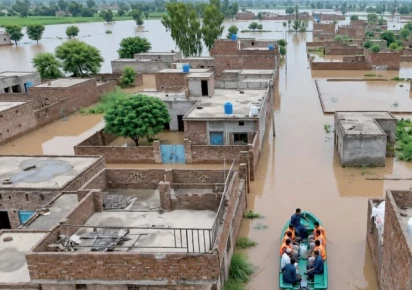
Flooding has worsened in Ferozewala after intense monsoon rains submerged dozens of villages and residential areas, leaving hundreds of families stranded. The situation is expected to become more challenging as the Pakistan Meteorological Department (PMD) has forecast another powerful spell of rain across Punjab and other parts of the country from July 29 to August 5.
According to the PMD, widespread rain and thunderstorms are likely to affect upper, central, and southern Punjab, with several districts expected to receive heavy to very heavy rainfall. The approaching weather system has increased the risk of urban flooding, flash floods, landslides, and rising river levels.
The Meteorological Department said strong monsoon currents from the Arabian Sea and the Bay of Bengal, combined with a westerly weather system, will bring continuous rainfall to cities including Lahore, Rawalpindi, Islamabad, Gujranwala, Gujrat, Sialkot, Faisalabad, Sargodha, Sahiwal, and nearby areas until August 4.
Southern Punjab districts, including Multan, Bahawalpur, Rahim Yar Khan, Vehari, Khanewal, Lodhran, Muzaffargarh, Kot Addu, Dera Ghazi Khan, and Rajanpur, are also expected to receive rainfall between July 31 and August 3.
The Punjab Disaster Management Authority (PDMA) has directed all district administrations and emergency departments to remain on high alert. Authorities have warned of possible urban flooding in major cities, while mountainous regions such as Murree and Galliyat face an increased risk of landslides. Flash floods are also possible in local streams, nullahs, and hill torrents across Punjab, Kashmir, Khyber Pakhtunkhwa, Islamabad, Gilgit-Baltistan, and northeastern Balochistan.
The warning comes as Ferozewala continues to battle severe flooding following the breach of an embankment along the seasonal Bhir Nullah, which submerged dozens of villages and residential settlements. Water levels continue to rise in several affected areas, forcing hundreds of families to seek safety.
Authorities have urged residents to avoid unnecessary travel during heavy rainfall, stay away from floodwaters, damaged buildings, exposed electrical wires, and move to safer locations during thunderstorms. Water and sanitation departments have also been instructed to keep drainage systems, pumps, and emergency machinery fully operational throughout the forecast period.