



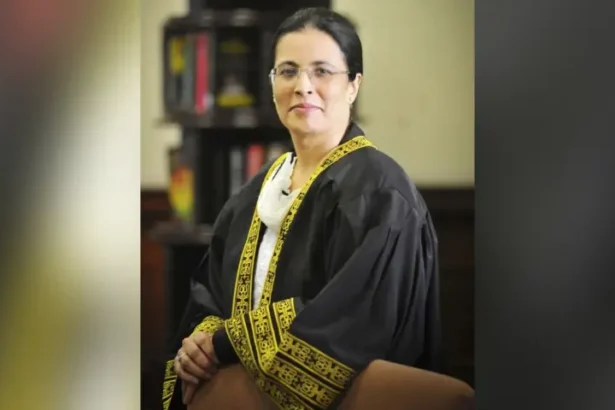
Supreme Court Justice Ayesha Malik has challenged victim-blaming attitudes surrounding sexual violence, stressing the need to change social perceptions that shift responsibility for rape from perpetrators to survivors. She made the remarks while addressing the launch of a judicial bench book designed to guide judges handling rape cases in gender-based violence (GBV) courts.
The event was organised through collaboration between Pakistan’s Ministry of Human Rights, the Legal Aid Society and the United Nations Population Fund (UNFPA). Justice Malik expressed concern that sexual violence had become so widespread that it no longer provoked the public response it deserved. She called for greater awareness and a justice system that treats survivors fairly and evaluates cases according to law and evidence.
The event also marked the release of a national study examining low conviction rates in gender-based violence cases. According to the Ministry of Human Rights, the bench book offers practical guidance on relevant legislation, judicial precedents and evidence assessment. Its 10 chapters follow the stages of a trial, helping judges navigate proceedings and make decisions based on applicable laws and evidence.
Rabeea Hadi, director general of the ministry’s Child Protection Institute, presented the study on low conviction rates. Prepared in collaboration with the Senate’s Functional Committee on Human Rights, the research examines challenges at different stages of the justice process, including initial complaints, police investigations, medico-legal examinations, prosecution and court proceedings.
Advocate Maliha Zia of the Legal Aid Society explained how the bench book could support judges during trials. Senator Ayesha Raza Farooq, chairperson of the Special Committee on the Anti-Rape (Investigation and Trial) Act 2021, highlighted the importance of turning legislation and superior court rulings into practical guidance for judicial officers.
Legal Aid Society Chief Executive Officer Barrister Haya Emaan Zahid discussed the difficulties survivors may face when reporting sexual violence and pursuing justice. She emphasised that delayed reporting, gaps in medical evidence and family power dynamics should be considered in context rather than automatically treated as reasons to disbelieve a complainant. UNFPA Pakistan Representative Dr Luay Shabaneh also stressed the importance of fair, well-reasoned judicial decisions in upholding human rights.
British High Commission Senior Governance Adviser Mary Kate Thomson said public confidence in the justice system depends on how cases are handled in practice, including how survivors are treated. Ministry of Human Rights Secretary Abdul Khalique Shaikh acknowledged the gap between legal protections and their implementation, calling for stronger efforts to ensure that safeguards provided by law are applied effectively.
The gathering brought together judges, prosecutors, parliamentarians, government officials, legal experts and development partners to discuss improvements in the handling of gender-based violence cases. The discussion comes amid continuing concerns about violence against women and vulnerable groups in Pakistan.
According to Sahil’s Six Months Cruel Numbers Report for January to June 2026, 3,172 gender-based violence cases were reported nationwide during the period, including 18 cases involving transgender persons. The report listed 644 murders, 514 cases of torture, 462 abductions, 363 suicides, 280 rapes, 175 cases of injury and 132 honour killings. Another 21 cases involved offences including harassment, gang rape and pornography. The figures highlight the importance of effective reporting mechanisms, fair investigations and judicial processes that assess evidence without relying on victim-blaming assumptions.