




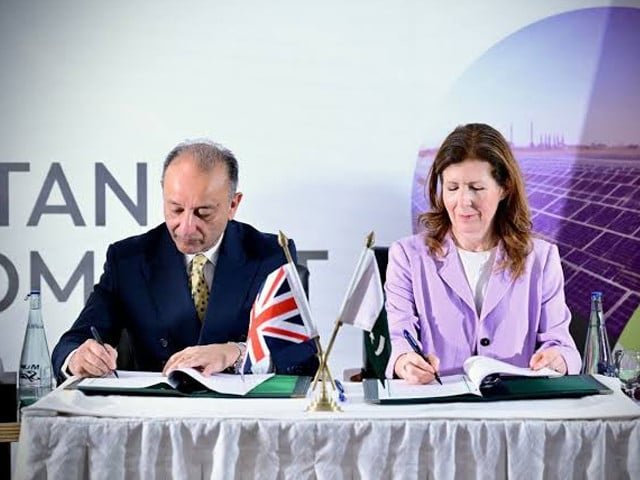
Pakistan and the United Kingdom have strengthened their climate partnership by advancing the implementation of the £35 million Green Compact, a bilateral cooperation framework aimed at enhancing Pakistan’s resilience against climate change and promoting sustainable development initiatives.
The development came during a meeting in Islamabad between British High Commissioner Jane Marriott and Federal Minister for Climate Change and Environmental Coordination Dr Musadik Malik. According to an official statement, both sides reviewed the Green Compact’s implementation strategy and discussed practical ways to ensure that the initiative delivers meaningful benefits to communities most vulnerable to climate-related challenges.
During the discussions, High Commissioner Jane Marriott presented the Green Compact’s action plan, outlining its major priorities and identifying potential areas for future collaboration. Climate Minister Dr Musadik Malik emphasized that all projects under the framework should focus on producing measurable and high-impact outcomes that directly improve the lives of people across Pakistan.
Focus on Youth and Green Innovation
A key area of discussion was the government’s vision of empowering young people through education, innovation, and entrepreneurship. Dr Musadik Malik briefed the British High Commissioner on ongoing efforts to establish a Green University in Islamabad, an institution dedicated to environmental education, climate research, and sustainable development studies.
The minister revealed that consultations are taking place with international partners, including Italy and stakeholders associated with the Arctic Circle initiative, to support the university’s development.
He also highlighted the establishment of a Green Tech Hub at the National University of Sciences and Technology (NUST) in collaboration with the Ministry of Climate Change and Environmental Coordination. The initiative aims to provide a platform for young entrepreneurs to develop innovative green technologies and sustainable business solutions capable of addressing environmental challenges.
Dr Malik stressed that Pakistan’s youth should not only participate in green entrepreneurship but should also be equipped with research opportunities and innovation tools to create practical, scalable, and long-term climate solutions.
Strengthening Disaster Preparedness
Climate resilience and disaster preparedness also featured prominently in the meeting. Jane Marriott shared details of the United Kingdom’s youth entrepreneurship programmes and ongoing climate-related initiatives being implemented in Pakistan through the British High Commission.
Both countries explored opportunities to improve early warning systems, enhance preparedness mechanisms, and strengthen responses to climate-induced disasters such as floods, heatwaves, and extreme weather events.
The official statement noted that Pakistan and the United Kingdom reaffirmed their commitment to working together under the Green Compact framework to deliver tangible results for vulnerable communities and build a more climate-resilient future.
The £35 million Green Compact represents another important step in Pakistan’s efforts to tackle environmental challenges through international cooperation, innovation, and investment in future generations.