



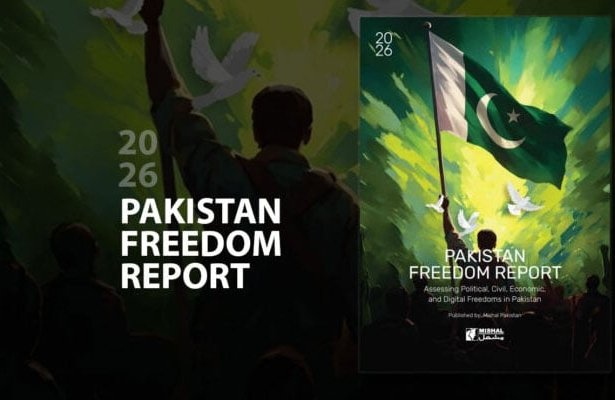
Mishal Pakistan has unveiled its first-ever State of Freedom Report 2026, prepared as a study under its role as a World Economic Forum country partner institute. The report offers a comprehensive assessment of constitutional freedoms, legal protections, and the everyday experiences of Pakistani citizens.
Based on a nationwide survey of 2,000 respondents, the report paints a complex picture of Pakistan’s social, economic, and governance landscape. Participants included highly educated individuals, with 67% holding graduate degrees, 32% possessing master’s qualifications, and 1% representing PhD-level education.
The report highlights Pakistan’s rapidly evolving digital environment. With the country’s population exceeding 245 million and nearly 64% under the age of 30, digital connectivity continues to shape economic opportunities and information consumption. Pakistan now boasts more than 195 million mobile connections, 145 million broadband subscribers, and over 230,000 kilometers of fiber optic infrastructure. ICT and freelance exports have surpassed $3 billion, reflecting the increasing contribution of the digital economy.
Citizens are increasingly relying on digital platforms for information. According to the findings, 24% primarily use Facebook, 19.9% depend on WhatsApp, 18% access websites, and 15% obtain information through X (formerly Twitter). However, 55% of respondents expressed concerns regarding access to unbiased and trustworthy digital information, citing misinformation, online harassment, and social polarization as growing challenges.
Economic freedom indicators presented a mixed outlook. Around 77% of respondents reported feeling free to choose their profession, while 75% supported freedom of business activity. Branchless banking services have expanded significantly, serving between 110 and 120 million users nationwide. Despite these gains, 58% voiced concerns over financial security, and only 35% believed the country was moving in a positive direction.
The report also examined gender and religious freedoms. Approximately 75% expressed satisfaction with opportunities for women’s advancement, while 45% believed equality across gender, religion, and ethnicity was improving. Regarding religious rights, 65% of respondents were satisfied with the protection of religious freedoms. Pakistan currently has nearly 600,000 mosques, 36,000 seminaries, around 2,000 churches, alongside temples and gurdwaras serving minority communities.
Governance and judicial efficiency emerged as areas of concern. The report documented more than 59,000 pending cases in the Supreme Court, over 450,000 cases in high courts, and approximately 1.74 million cases awaiting disposal in district courts. Prison overcrowding remains severe, with occupancy rates reaching 166% in Punjab and 161% in Sindh.
In the education sector, primary school enrollment stands at 69%, while higher education enrollment remains limited at approximately 13%. Furthermore, 62% of respondents felt they had limited influence over government decisions, indicating concerns regarding citizen participation and representation.
The State of Freedom Report 2026 concludes that personal freedom in Pakistan is deeply interconnected with economic opportunity, justice, governance quality, security, and digital inclusion. It calls attention to both the country’s achievements and the significant structural challenges that remain in strengthening freedoms and improving citizens’ lived experiences.