

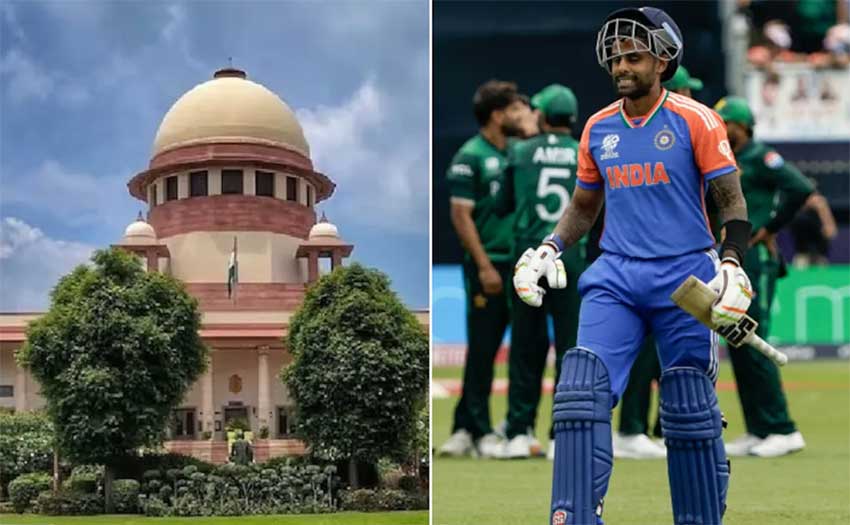
— Rising tensions, legal challenges, and shifting narratives ahead of Asia Cup 2025 clash
New Delhi / Islamabad, September 11, 2025 — The upcoming India vs Pakistan Asia Cup 2025 match, scheduled for September 14 in Dubai, is under legal and political fire after a group of law students filed a Public Interest Litigation (PIL) in the Indian Supreme Court demanding its cancellation. The petition, rooted in national security concerns and public sentiment following the Pahalgam terror attack and Operation Sindoor, has stirred controversy across both sides of the border.
🇮🇳 The Indian Petition: Cricket vs National Sentiment
The PIL argues that staging the match just weeks after a deadly attack undermines national dignity and disrespects the sacrifice of security forces and civilians. It calls on the court to prevent the match and enforce the National Sports Governance Act, 2025, bringing the BCCI under closer scrutiny and government oversight.
Petitioners claim the match promotes “an illusion of normalcy and camaraderie” with a country accused of aiding cross-border terrorism. They further contend that sports should not be used as a diplomatic channel at a time of national mourning and heightened tension.
🇵🇰 Pakistan’s Reaction: “An Indirect Acknowledgment of Defeat”
In Pakistan, the legal challenge is being viewed through a very different lens. Political analysts, media commentators, and social media users have widely interpreted the PIL as an indirect admission of Pakistan’s psychological victory in the aftermath of Operation Sindoor.
Commentators on Pakistani television channels have argued that the call to cancel the match suggests India is feeling vulnerable—both emotionally and diplomatically—following its military operation. “If India truly emerged victorious from Operation Sindoor, why are they hesitating to play a cricket match? This is more than a game—this is a narrative war, and they’ve blinked first,” said one prominent analyst during a primetime news segment.
Pakistani fans and media personalities have also questioned whether India’s legal move reflects internal divisions and growing public pressure not to normalize relations, even in a sporting arena. For many, this legal action is seen not just as a reaction to a tragedy but as a signal that Pakistan has successfully disrupted India’s sporting and diplomatic posture.
⚔️ Strategic Silence from Team India
Indian captain Suryakumar Yadav, facing pressure both on and off the pitch, has avoided commenting directly on the PIL. He remains focused on preparation, though analysts suggest that the emotional stakes of the match are now far higher than initially expected.
Meanwhile, Shubman Gill’s recent social media post, interpreted by fans as a subtle nod to national sentiment, has only intensified the pre-match build-up. While no official statement has been made by the Indian team, internal sources indicate a high-level strategy meeting is being held to prepare for both the match and the media narrative around it.
⚖️ What’s at Stake?
The PIL has raised critical legal, diplomatic, and emotional questions. Should sports be insulated from politics? Does continuing to play with a geopolitical rival signify strength—or weakness? And who, if anyone, really wins when cricket becomes a battlefield?
If the match is cancelled, it could set a powerful precedent—not only in sports law but in the way diplomacy and national security are balanced in public policy. On the other hand, if the court allows the match to proceed, it may signal a commitment to separating statecraft from sport, even under pressure.
Regardless of the legal outcome, Pakistan’s narrative victory is already being celebrated domestically. The perception that India is retreating—not from the field, but from the optics of sporting rivalry—has energized public opinion and added momentum to Pakistan’s media and diplomatic positioning.
🧭 Looking Ahead
The Indian Supreme Court is expected to review the PIL in the coming days. Meanwhile, players, fans, and governments on both sides of the border are watching closely. The outcome of this legal challenge may shape not just one cricket match, but the future of sports diplomacy in South Asia.