


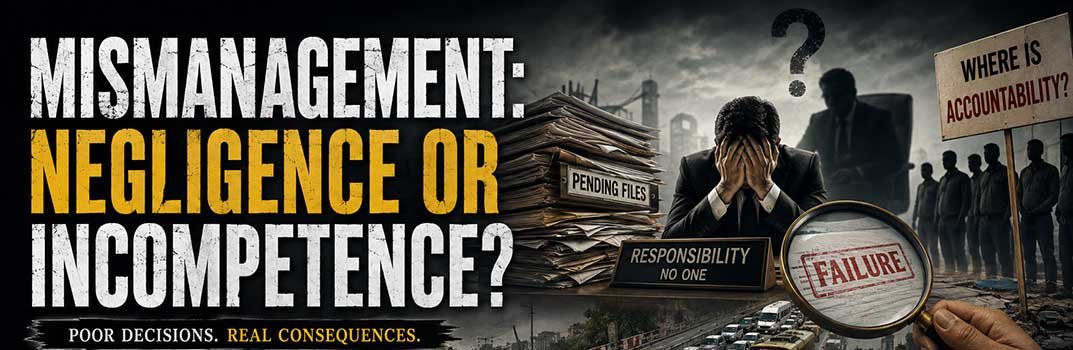
 The world is full of surprises. Times never remain constant, and people change. Life is like a flow; you cannot control everything. Sometimes, shockingly, you cannot even control your own moods, money, emotions, or circumstances. Everything is unpredictable and, to some extent, uncontrollable.
The question is: If everything around us is so fast, complicated, and unpredictable, how can one manage oneself and the world around them? Is mismanagement an inherited trait, the result of incomplete learning, or simply a consequence of circumstances?
Why do people mismanage almost everything—from their personal lives to their professional responsibilities and social relationships?
We often become incompetent despite having a multitude of knowledge and confidence. We struggle a lot but gain very little compared to the amount of effort we put in. We invest our emotions, energy, time, and loyalty in every relationship and every goal, yet sometimes the results are almost nothing. This cycle of continuous mismanagement can leave a person exhausted, frustrated, and disappointed.
But perhaps the real problem is not always a lack of intelligence, knowledge, or hard work. Sometimes, the problem is that we have never learned how to manage ourselves.
The first step towards solving mismanagement is self-awareness. We must honestly identify where we are failing. Are we wasting our time? Are we making decisions emotionally? Are we trying to control things that are beyond our control? Are we investing too much in people or situations that give little in return? Without understanding the problem, we cannot manage it.
The second step is prioritization. We cannot give equal importance to everything. Life requires us to decide what truly deserves our time, energy, emotions, and attention. Not every relationship needs our constant sacrifice, not every problem needs our immediate reaction, and not every goal needs to be pursued forever.
The third step is learning to manage emotions before making decisions. Anger, fear, attachment, disappointment, and insecurity can all influence our judgment. Sometimes, taking a pause before reacting can prevent years of regret. Emotional maturity is not the absence of emotions; it is the ability to respond wisely despite them.
We also need to understand the difference between effort and effectiveness. Working harder does not always mean achieving more. Sometimes, we need to change our strategy rather than simply increase our effort. If something repeatedly fails, we must be willing to reflect, learn, adapt, and try a different approach.
Another important solution is learning to accept what we cannot control. We cannot control other people’s behavior, the passage of time, unexpected events, or every outcome in life. But we can control our choices, our boundaries, our reactions, and the way we respond to difficult circumstances. Acceptance is not surrender; it is learning where to place our energy.
We must also learn the importance of boundaries. Mismanagement often occurs when we constantly give ourselves to everyone and everything. Saying “no” when necessary, protecting our time, and recognizing when a relationship or situation is unhealthy are not acts of selfishness. They are acts of self-management.
Finally, effective management requires continuous learning. We should be willing to admit when we do not know something, seek advice, learn from our mistakes, and change our behavior. Knowledge becomes valuable only when it is transformed into action.
Perhaps mismanagement is not always negligence, and it is not always incompetence. Sometimes, it is simply the result of incomplete learning. We are expected to manage our careers, relationships, finances, emotions, and responsibilities, yet many of us were never taught how to manage ourselves.
Maybe the ultimate solution is not to control the uncontrollable world around us, but to become better managers of our own inner world.
We cannot control the flow of life, but we can learn how to navigate it. We cannot manage everything, but we can learn what deserves to be managed. And perhaps true competence begins when we learn to manage ourselves before attempting to manage the world around us.