
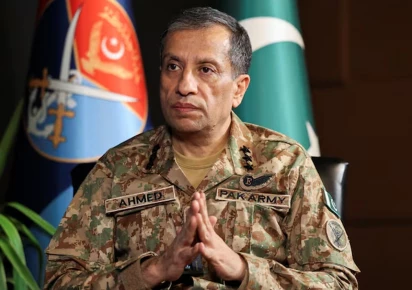
Pakistan’s military has expressed cautious optimism about Islamabad’s diplomatic efforts to reduce tensions between Iran and the United States. Inter-Services Public Relations (ISPR) Director General Lieutenant General Ahmed Sharif Chaudhry said repeated visits by Chief of Defence Forces and Chief of Army Staff Field Marshal Asim Munir to Tehran reflected positive signs in Pakistan’s mediation efforts.
Speaking during an interview in Rawalpindi, Chaudhry said the visits indicated that there could be progress in diplomatic engagement. However, he emphasised that Pakistan remained cautiously optimistic, noting that groups opposed to peace could still create challenges for negotiations.
Field Marshal Asim Munir visited Tehran twice during the month as Pakistan increased its diplomatic engagement between Washington and Tehran. During his latest visit, he was accompanied by Saudi Defence Minister Prince Khalid bin Salman and Turkish intelligence chief Ibrahim Kalin. Chaudhry declined to disclose details of the discussions or confirm whether the United States had endorsed the delegation’s visit.
The ISPR chief also discussed the Makkah Joint Defence Agreement signed by Pakistan, Saudi Arabia and Türkiye on August 7. He said the agreement did not prevent other countries from joining the arrangement. Responding to a question about possible Iranian membership, he said countries committed to collective deterrence and regional peace would be welcome, although any expansion would require a decision by the political leadership of the three signatories.
Under the agreement, an attack on any one of the three countries would be treated as an attack on all three. The arrangement has attracted attention amid the wider regional consequences of the Iran-US conflict and concerns about further escalation in the Middle East.
Chaudhry also addressed questions about Pakistan’s military commitments to Saudi Arabia. He said any decision to deploy additional Pakistani troops would depend on the evolving security situation and consultations between the political leadership of both countries. He reiterated Pakistan’s commitment to Saudi Arabia and the protection of the holy sites in Makkah and Madina, while clarifying that Pakistan was not involved in the conflict in Yemen.
The military spokesman further commented on the security situation in Khyber-Pakhtunkhwa and defended the armed forces’ counterterrorism strategy. He said operations in the province were based on intelligence-led action rather than conventional military campaigns, adding that the pace of intelligence-based operations would be increased.
The discussion comes amid political disagreements between the federal government and Pakistan Tehreek-e-Insaf (PTI) over security and governance in Khyber-Pakhtunkhwa. The federal government accused the provincial administration of failing to control militancy, while PTI rejected the allegations and described the suspension of its provincial administration as an attempt to suppress political opposition.
Pakistan’s military leadership has maintained that national security remains its primary responsibility. Meanwhile, Islamabad continues to face diplomatic challenges linked to regional tensions as well as domestic security concerns.