
US-Pakistan relationship: Why public diplomacy matters more than military ties now?
For many years now, the relationship between America and Pakistan has primarily revolved around matters of security. It is through military alliance that the two nations interacted and engaged each other during the Cold War and in the War on Terror respectively. However, in the current dynamic environment of international politics, this approach seems quite obsolete. In light of this and considering the persisting mutual mistrust, the future of the America–Pakistan relationship will be determined by how well the two nations engage in public diplomacy.
In past times, military cooperation was advantageous for both states, albeit in a limited way. The former gained money, military equipment, and strategic assistance, while the latter could not attain its regional ambitions without the help of Pakistan, especially in Afghanistan, which neighbors it. Nevertheless, their interaction was frequently characterized by inequality and distrust. Short-term security-oriented policies did not allow for a wider social agenda, making it difficult to maintain consistent trust.
The situation today has become entirely different. Following the United States’ pullout from Afghanistan, which was completed in 2021, the significance of Pakistan in America’s strategic thinking has diminished. Moreover, in recent times, Pakistan is looking to revise its approach towards international relations to focus on stability and connectivity. In such circumstances, the military aspect of a bilateral relationship will not be enough.
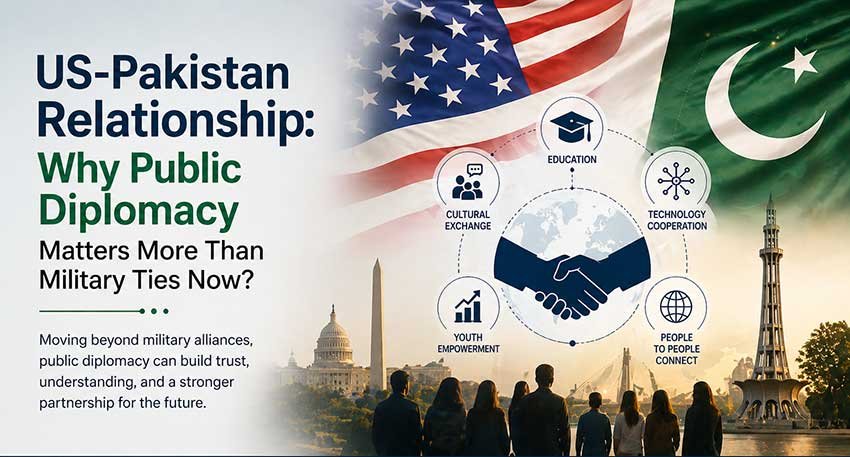
Public diplomacy is generally understood as the attempts made by the state to reach out directly to the people of another country for the purpose of shaping their perceptions and building understanding and relations. It encompasses areas such as education, culture, development, and even the digital world in the case of the U.S. Public diplomacy in Pakistan has often been overlooked due to its emphasis on security links.
The Fulbright Program provides one of the clearest illustrations of an effective public diplomacy initiative, having provided opportunities for many Pakistani students to pursue their education in the United States. Such interactions not only build personal and professional relationships that may influence future perceptions of each other’s society but also give the participants better insights into American culture and governance systems, while acting as unofficial ambassadors of Pakistan in the United States. The investment made in such initiatives may prove to be far more rewarding in the long run than any immediate military assistance.
Likewise, programs that concentrate on entrepreneurial activities, climatic resilience, and technology cooperation open up new possibilities for cooperation. The young demographic profile of Pakistan, wherein more than 60 percent of its citizens are less than 30 years old, is both an impediment and a potential area for cooperation. Through investment in education, innovation, and skill development, the US can become a partner in helping Pakistan achieve socio-economic progress, instead of just becoming a security partner to it.
Public diplomacy in the digital era has transcended from conventional diplomacy to social media diplomacy. Social media platforms like TikTok, X, and YouTube have become important mediums for public diplomacy efforts. It is imperative for U.S. policymakers to maintain a coherent, credible, and culturally sensitive message strategy when conducting public diplomacy in the digital era. In the case of Pakistan, whose public opinion is largely influenced by its foreign policy doublespeak, it is essential to conduct public diplomacy effectively through social media.
Nevertheless, the effectiveness of public diplomacy is highly contingent upon a congruence between words and deeds. The dissonance between U.S. rhetoric and policies constitutes one of the persistent problems in the context of the U.S.-Pakistan relationship. Such concerns as drone attacks, changing allegiances, and inconsistencies in the promotion of human rights have fostered distrust and suspicion among Pakistanis. In absence of resolving those issues, public diplomacy may encounter difficulties.
The criticism could be that security cooperation is necessary due to existing threats like terrorism in the region, but this does not diminish the significance of taking a broader perspective. It is important to note that public diplomacy will help advance the aims of security cooperation because of its ability to tackle underlying issues of distrust and develop positive relations with the people. An alliance that is supported by the people will be stronger against political changes.
Each country is now faced with a decision to make. It either continues on its path of a superficial relationship based on mere security considerations, which have been shown time and again to be weak and unreliable, or builds up a deeper relationship based on mutual understanding and respect. Public diplomacy may not yield immediate results but has great possibilities in terms of making such relationships stronger in the long run.
In conclusion, the time of U.S.-Pakistani relations being centered on military matters is over. While the military relationship will be one factor within the equation, it cannot act as the bedrock of the partnership anymore. Instead, public diplomacy using methods like education, culture, and technology is a stronger route to take. Rather than perpetuating the vicious circle of dependency and distrust from before, public diplomacy allows for a real partnership between the two nations in today’s world.
Biography:
I am Vaneeza Malik, a student of International Relations at Fatima Jinnah Women University (FJWU), Rawalpindi. My academic interests include public diplomacy, foreign policy, and global affairs, and I am particularly interested in analyzing U.S-Pakistan relations and emerging geopolitical trends.