
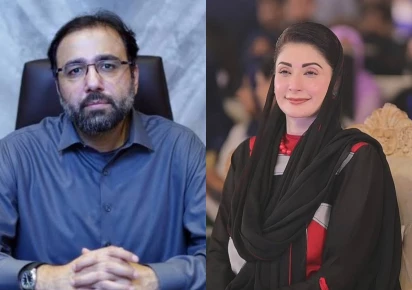
Punjab Chief Minister Maryam Nawaz has issued a Rs5 billion defamation notice to Federal Minister Chaudhry Salik Hussain over his allegations of widespread corruption in the province. The legal notice demands an unconditional apology, withdrawal of the statements and financial compensation. It has also been served on an ARY News anchor and the private television channel’s chairman over the broadcast of the interview in which the allegations were made.
The dispute followed Salik Hussain’s appearance on a private television talk show, where he praised his paternal uncle, former Punjab chief minister Chaudhry Pervez Elahi, for his 2002–2007 tenure. He described Elahi as the province’s best chief executive and credited his administration with carrying out development work across Punjab without political discrimination.
In the same interview, Salik criticised the current provincial government, alleging that political considerations were influencing development priorities and the distribution of public funds. He claimed that a disproportionate share of Punjab’s development budget was being spent in Lahore, while districts such as Gujrat were being neglected because government-backed candidates had lost elections there. He also alleged that corruption-related files had accumulated in government offices, although he acknowledged that he did not have direct evidence to substantiate his claims.
Maryam’s legal notice described the allegations as baseless and damaging to the reputation of the chief minister and the provincial administration. It argued that Salik had not identified any specific department, government official, development project, financial transaction or corruption inquiry to support his statements. The notice also questioned whether his claims were based on official investigations, audit reports, complaints or other verifiable records.
Addressing the controversy at a laptop distribution ceremony, Maryam challenged the federal minister to provide evidence for his allegations or face legal proceedings. She rejected claims that her government was directing development resources towards selected areas and maintained that appointments of deputy commissioners, commissioners and regional police officers were made on merit rather than political recommendations.
The chief minister also defended her government’s development work in Gujrat, recalling problems with rainwater accumulation in the city when she took office. She said projects worth billions of rupees had since been undertaken and stated that she was prepared to be held accountable for public spending. She also disputed Salik’s positive assessment of Pervez Elahi’s tenure, arguing that Gujrat had remained neglected under previous administrations.
Salik, however, refused to withdraw his allegations and maintained that corruption existed in Punjab. He also rejected the suggestion that his criticism was connected to the appointment of a deputy commissioner in Gujrat, saying the interview had been recorded around three weeks earlier. He stood by his remarks but did not present documentary evidence when asked to substantiate them.
Punjab Information Minister Azma Bokhari also criticised Salik, alleging that his remarks were linked to personal displeasure after a request for a preferred deputy commissioner in Gujrat was rejected. She maintained that administrative appointments were not made on personal recommendations and defended the government’s approach to development spending across the province.
Bokhari said Rs12 billion had been allocated for development projects in Gujrat and cited the expansion of the provincial government’s sanitation model into rural areas. She also rejected claims that development resources were concentrated in Lahore.
The controversy has attracted further political attention because Salik Hussain’s brother, Chaudhry Shafay Hussain, is part of Maryam Nawaz’s provincial cabinet and serves as Punjab’s minister for industries, commerce and investment. The dispute centres on competing claims about corruption, development spending and administrative appointments, while the legal notice has placed the matter on a potential legal course.