

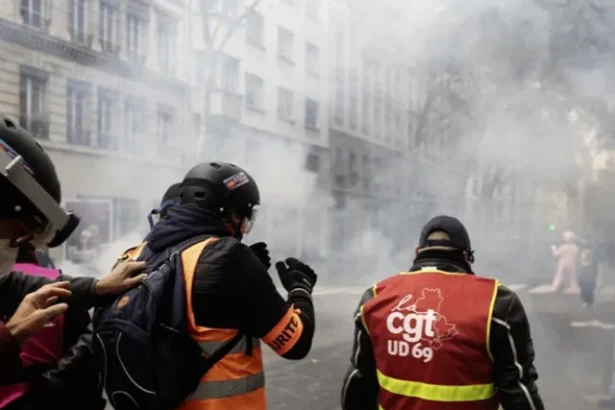
Nearly 600,000 people took part in demonstrations across France on Thursday, marking the largest turnout since the current protest movement began, according to provisional figures released by the Interior Ministry. The protests were accompanied by a nationwide strike over wages, declining purchasing power and concerns about public services.
The Interior Ministry’s estimate, reported by BFMTV, showed an increase compared with previous demonstrations. Authorities recorded around 550,000 participants on October 17, followed by approximately 410,000 on October 24 and 320,000 on October 31. However, the General Confederation of Labour (CGT), one of France’s major trade union organisations, estimated nationwide attendance at nearly 1.6 million people. The union also reported that around 350,000 demonstrators joined the march in Paris.
CGT Secretary-General Sophie Binet described the industrial action as highly effective and called on the government to respond to workers’ demands. Addressing demonstrators in Paris, she urged authorities to increase wages for all workers and raise the minimum wage by 10 per cent. She also said the protest movement would continue until workers received a response to their demands.
The nationwide strike affected educational institutions and universities. According to the Education Ministry, nearly 16 per cent of teachers participated in the industrial action. The Higher Education Ministry reported disruptions at 60 of France’s 184 universities and other higher education institutions.
Meanwhile, the SNES-FSU union estimated that 52 per cent of middle and high school staff had joined the strike. Authorities also intervened to clear student blockades in several cities, including Paris and Bordeaux.
To manage the demonstrations, the Interior Ministry deployed 70,000 police officers and gendarmes across the country. The large-scale security presence came as workers and students continued to raise concerns about wages, education conditions, funding and staffing shortages.
Amid growing pressure from trade unions, Prime Minister Sebastien Lecornu announced that a social conference involving union representatives and employers’ organisations would take place at Matignon on Monday, November 9. The meeting is expected to provide a forum for discussions between the government, workers’ representatives and employers.
The latest demonstrations follow a student-led protest movement that began in mid-September, initially focusing on education conditions, funding and staffing shortages. The movement has since expanded to include wider demands concerning wages, purchasing power and public services.