
ISLAMABAD: Prime Minister Shehbaz Sharif has ordered immediate action against eight officials named in the preliminary inquiry into the devastating fire at the Pakistan Institute of Medical Sciences (PIMS) neonatal ward that claimed the lives of 14 newborns.
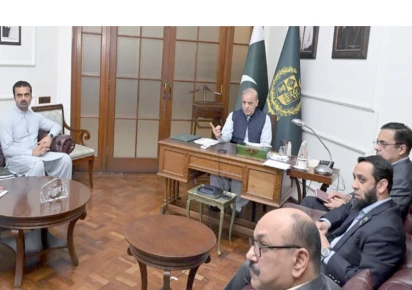
The decision was taken during a meeting chaired by the prime minister, where the inquiry committee presented its interim findings and reviewed CCTV footage reconstructing the incident.
Shehbaz Sharif approved the suspension of the officials and directed that departmental proceedings be initiated. He also ordered criminal proceedings against anyone found responsible for criminal negligence, stressing that no individual involved in the tragedy should receive preferential treatment.
Those facing action include PIMS Executive Director Prof Dr Imran Sikandar, Joint Executive Directors Dr Mutahir Shah and Dr Owais Ali Shah, neonatal department head Prof Dr Sadia Riaz, senior registrar Dr Naghma, Dr Nousheela Amjad, Assistant Director Security Mohammad Usman and CDA Emergency Services Director General Dr Abdul Rehman.
Action has also been ordered against the private security company operating at the hospital and officials associated with it.
The prime minister expressed solidarity with the families who lost their newborns and stressed that exemplary punishment should be awarded wherever negligence is established.
Nurse Razia Noreen honoured
Prime Minister Shehbaz Sharif also approved the Sitara-e-Khidmat for nurse Razia Noreen, who entered the burning neonatal ward and rescued a newborn.
According to the Prime Minister’s Office, she will also receive a cash reward of Rs10 million for her bravery.
CCTV footage reviewed by the inquiry committee showed Noreen entering the nursery as the situation rapidly deteriorated. She emerged carrying a newborn and later attempted to return to the ward.
The prime minister praised her courage and dedication, describing her actions as an extraordinary commitment to duty.
Meanwhile, a nurse and female security guard present in the ward have been placed off duty and assigned special duty pending further investigation. Dr Mohammad Salman, CEO of the National Institutes of Health, has been appointed acting executive director of PIMS.
Fire cause remains undetermined
The inquiry committee has not yet established the exact source of the fire. Possible sources examined included an air conditioner, incubator, warmer and electrical equipment.
Investigators noted that Islamabad Electric Supply Company records showed no fault or tripping on the external power feeder when the fire occurred. The committee is therefore examining PIMS’s internal electrical network, including wiring, sockets, plugs and connected equipment.
The inquiry also stressed that identifying the ignition source alone was not enough. Investigators said attention must also be given to the safety failures that allowed a relatively contained fire to develop into a mass-casualty incident.
CCTV reveals rapid deterioration
The committee used CCTV footage to reconstruct the sequence of events and described it as the most reliable available account.
At around 6:38am, charge nurse Nasreen was seen leaving the nursery and seeking assistance. Shortly afterwards, she and security guard Maria entered the nursery as flames became visible.
Nurse Razia Noreen entered at approximately 6:38:56am and returned seconds later carrying a newborn. She then attempted to enter the ward again.
Within moments, smoke severely reduced visibility on the cameras. The committee concluded that conditions inside the nursery deteriorated extremely quickly, with the situation becoming catastrophic within roughly two minutes.
Serious safety shortcomings identified
The interim report identified major weaknesses in PIMS’s fire preparedness. Although the hospital had several standard operating procedures, investigators found insufficient evidence of a dedicated and regularly practised fire and evacuation plan specifically for the neonatal nursery.
The report highlighted gaps in procedures covering fire detection, alarm activation, emergency communication, incident command, extinguisher use, isolation of oxygen and electricity, emergency exits and evacuation of newborns unable to move independently.
Emergency exits and escape routes have also come under scrutiny. A separate assessment by Capital Emergency Services reportedly found some routes locked or obstructed, with firefighters having to force open certain doors and access points.
However, investigators cautioned that a locked door alone would not automatically establish negligence, as controlled access may have legitimate security reasons. The committee will determine whether the doors were designated emergency exits and whether their condition delayed rescue or evacuation.
Hospital-wide safety audit ordered
The inquiry committee has recommended an immediate comprehensive fire, life-safety and electrical audit of PIMS, preferably by independent technical experts.
High-risk areas such as neonatal wards, intensive care units and operating theatres have been prioritised. The committee called for inspections of smoke and heat detectors, alarms, fire extinguishers, hydrants, emergency lighting, electrical protection systems and fire exits.
It also recommended technical checks of incubators, warmers, air-conditioning systems, IVAC equipment, electrical sockets, distribution boards, circuit breakers and earthing systems.
The committee further called for practical fire and neonatal evacuation drills involving medical, nursing, security and engineering staff, along with a clear emergency command and communication system.