
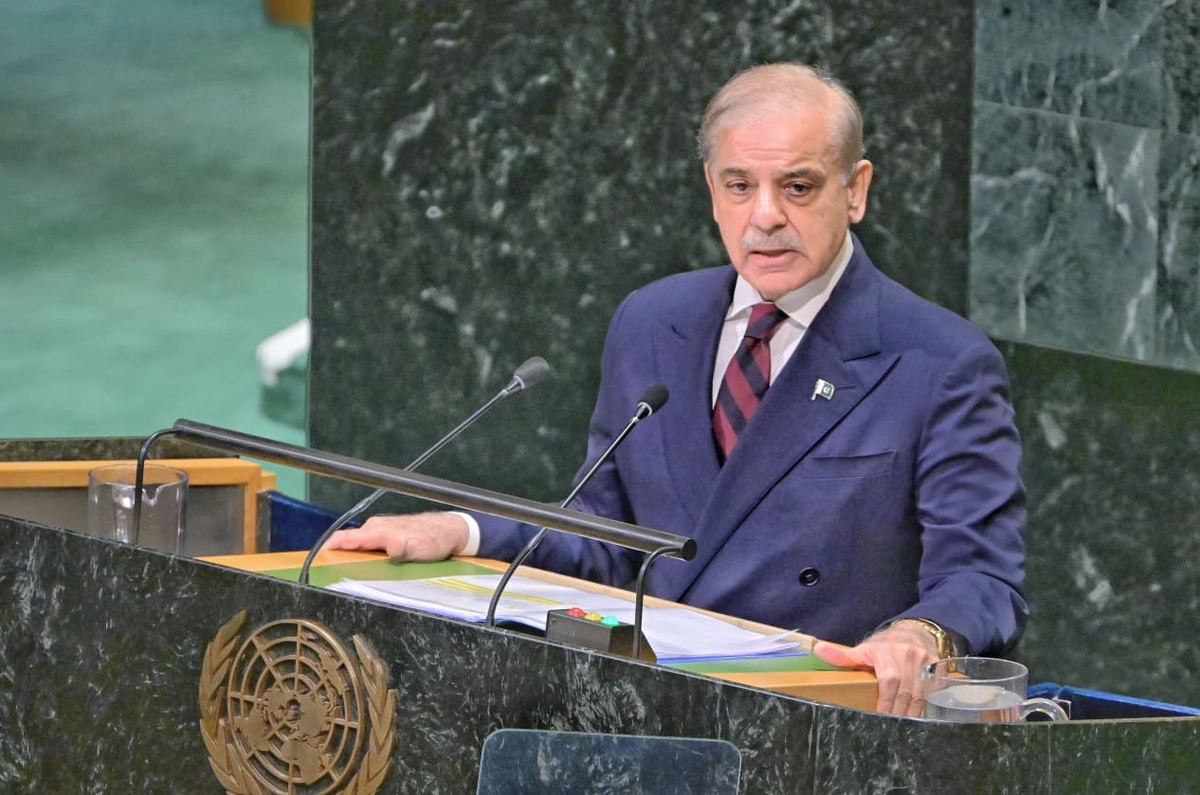
Prime Minister Shehbaz Sharif has called for renewed diplomatic efforts to reduce escalating tensions in the Middle East, telling the United Nations General Assembly that the Strait of Hormuz and Bab al-Mandab must remain open for global connectivity, trade and economic activity.
Addressing the 81st session of the UN General Assembly in New York, PM Shehbaz described the two strategic waterways as important arteries of the global economy. He said they should connect nations and support prosperity rather than become points of confrontation amid continuing regional tensions.
The prime minister highlighted Pakistan’s diplomatic efforts during the Middle East conflict and stressed that diplomacy should remain at the centre of international efforts to resolve disputes. He said Pakistan had chosen dialogue, cooperation and peace over confrontation and coercion.
PM Shehbaz also referred to the Makkah Joint Defence Agreement between Pakistan, Saudi Arabia and Türkiye. He said the agreement was not directed against any country and described it as a collective commitment to defence, regional stability and peace.
The prime minister strongly condemned attacks targeting Saudi Arabia and expressed solidarity with the Saudi people. He also said the safety and sanctity of the Haramain Sharifain must be protected.
On Palestine, PM Shehbaz reiterated Pakistan’s position in support of an independent and sovereign Palestinian state based on the pre-1967 borders, with Al-Quds Al-Sharif as its capital. He also condemned Israeli military actions in Gaza and other parts of the region and called for an end to hostilities.
The prime minister also addressed the Kashmir dispute, reaffirming Pakistan’s stated support for the Kashmiri people’s right to self-determination. He called for a peaceful and just resolution of the dispute and referred to Pakistan’s position regarding developments in Jammu and Kashmir.
Water security was another major issue in his address. Referring to the Indus Waters Treaty, PM Shehbaz said water should not be used as a weapon and warned that any attempt to stop, impede or divert Pakistan’s share of the Indus waters would be treated by Pakistan as an act of war.
He also raised concerns about terrorism and alleged that militant groups, including the Tehreek-e-Taliban Pakistan and Balochistan Liberation Army, were operating from Afghan territory. He called on Afghan authorities to take what he described as verifiable and decisive action against attacks targeting Pakistan.
Beyond regional security, PM Shehbaz urged the international community to give development the same level of attention as security. He called for debt relief, affordable long-term financing and greater climate financing for developing countries.
The prime minister noted Pakistan’s vulnerability to climate change and urged developed countries to meet their climate-finance commitments, including support for adaptation, resilience and loss and damage.
On the domestic economic front, PM Shehbaz said Pakistan was pursuing structural reforms and fiscal discipline while working towards sustainable economic growth. He highlighted efforts to modernise agriculture and industry, develop mineral resources, expand digitalisation and equip young people with artificial intelligence and information technology skills.
He also highlighted Pakistan’s economic and connectivity plans involving China through CPEC, as well as stronger links with Gulf countries, Central Asia and other regions.