
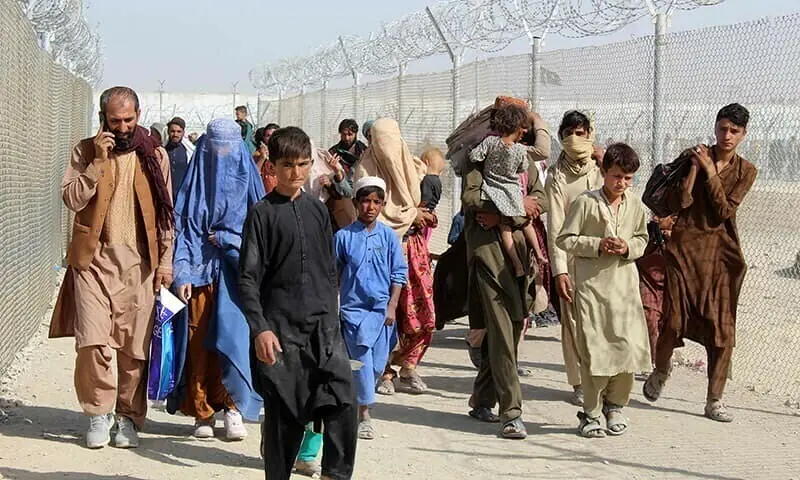
The repatriation of undocumented Afghan nationals through the Torkham border crossing has significantly accelerated following improvements to the verification process at the Hamza Baba Transit Centre in Landi Kotal, officials and sources familiar with the operation have confirmed.
According to authorities overseeing the process, approximately 4,000 Afghan nationals are being processed daily before their return to Afghanistan through the Torkham border. The enhanced procedures have reduced congestion and improved the efficiency of the repatriation operation.
Officials explained that changes introduced at the transit centre require Afghan nationals to appear individually for identity verification and clearance. Meanwhile, vehicles carrying their belongings are processed separately after completing customs formalities and security inspections.
Authorities said the revised mechanism has helped streamline operations while reducing opportunities for irregularities and fraudulent practices.
An official, speaking on condition of anonymity, stated that the Hamza Baba Transit Centre maintains close coordination with authorities in Peshawar and other regions to facilitate the orderly movement of returnees.
According to the official, vehicles are only permitted to proceed towards the Torkham border after obtaining clearance from traffic wardens responsible for the Peshawar–Torkham Highway and verification by National Database and Registration Authority (NADRA) staff stationed at the transit facility.
The official further revealed that the centre verifies and clears between 800 and 1,000 adult Afghan nationals every day, including both men and women. On average, each adult is accompanied by approximately five children.
Authorities noted that the entire verification and clearance process generally takes around 15 minutes, provided all required documents are valid and complete. Children below the age of 12 are exempt from undergoing the verification procedure.
Officials stated that individuals carrying suspicious, forged, or questionable documents are subjected to more detailed investigations. In such cases, NADRA officials conduct additional checks to verify identities and authenticate credentials before making final decisions.
Where individuals lack documentation entirely, officials also question parents and other family members to establish nationality and determine eligibility for repatriation.
Authorities disclosed that verification procedures have also helped uncover alleged human trafficking activities. Officials claimed that organised trafficking networks had attempted to move local women into Afghanistan by falsely presenting them as Afghan nationals.
Several women and their alleged facilitators were reportedly identified and detained after failing to establish Afghan nationality during the verification process.
Officials further stated that many of the undocumented Afghans returning to Afghanistan were actually born and raised in Pakistan and had never visited Afghanistan before.
Most returnees, according to authorities, are under the age of 30 and belong to economically disadvantaged families. Many reportedly express reluctance to leave Pakistan due to uncertainty about their future, lack of resources, and limited familiarity with conditions across the border.
Despite these concerns, the repatriation drive has continued at a rapid pace since the reopening of the Torkham border crossing.
Officials claimed that approximately 200,000 Afghan nationals have been repatriated since March 31, when operations resumed through the border point.
The accelerated repatriation process reflects Pakistan’s ongoing efforts to regulate undocumented migration while maintaining security and administrative oversight at one of the country’s busiest international crossings.
Authorities maintain that the verification system is designed to ensure transparency, prevent misuse of official procedures, and facilitate the lawful return of undocumented individuals while addressing humanitarian considerations wherever possible.
As operations continue, the Torkham border remains a focal point in Pakistan’s broader immigration and border management strategy amid evolving regional challenges.