
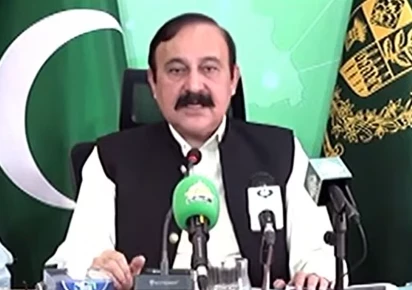
The federal government has called on the recently banned Joint Awami Action Committee (JAAC) to abandon violence and pursue its demands through constitutional and democratic channels. Speaking outside Parliament House, Federal Minister for Parliamentary Affairs Dr. Tariq Fazal Chaudhry clarified that the government is not engaged in direct negotiations with the outlawed group. However, he noted that there would be no objection if Azad Jammu and Kashmir (AJK) Prime Minister Chaudhry Anwar-ul-Haq facilitated indirect dialogue aimed at restoring peace.
Dr. Tariq Fazal emphasized that disputes should be resolved through negotiations rather than confrontation, urging the JAAC leadership to prioritize stability and public welfare. He stated that violence only deepens divisions and undermines efforts to address legitimate concerns through democratic processes.
The minister highlighted that the government had already accepted 35 out of the 38 demands presented by the JAAC. According to him, the remaining demands could not be implemented due to ongoing legal and constitutional constraints. As part of confidence-building measures, authorities withdrew 170 cases registered against protesters and announced compensation packages for the families of civilians and law enforcement personnel who lost their lives during the unrest.
He further stated that employment opportunities had been offered to relatives of the deceased and pointed to administrative reforms introduced in AJK. These reforms included reducing the cabinet size from 36 members to 20 and decreasing the number of ministries from 32 to 22, in line with previous commitments.
Addressing the issue of the 12 refugee seats in the AJK Legislative Assembly, Dr. Tariq Fazal argued that any modifications must be pursued through political, legislative, or judicial mechanisms, as the current arrangement is protected under the interim constitution of Azad Jammu and Kashmir.
Meanwhile, the unrest has intensified political tensions ahead of the upcoming AJK elections scheduled for July 27. Police reported that four law enforcement personnel were killed and dozens injured during clashes, while authorities claimed protesters attacked public property and security institutions. Between June 6 and June 14, officials said 81 cases were registered, resulting in the arrest of 425 individuals.
However, the JAAC has rejected the government’s narrative, alleging that security forces used excessive force against demonstrators. The group claims that seven civilians were killed and many others injured during the protests. The dispute over refugee representation continues to remain at the center of the political crisis, fueling debate and uncertainty across the region.
As calls for calm continue from political leaders, observers believe that meaningful dialogue within the constitutional framework remains crucial to preventing further escalation and ensuring stability in Azad Jammu and Kashmir.