
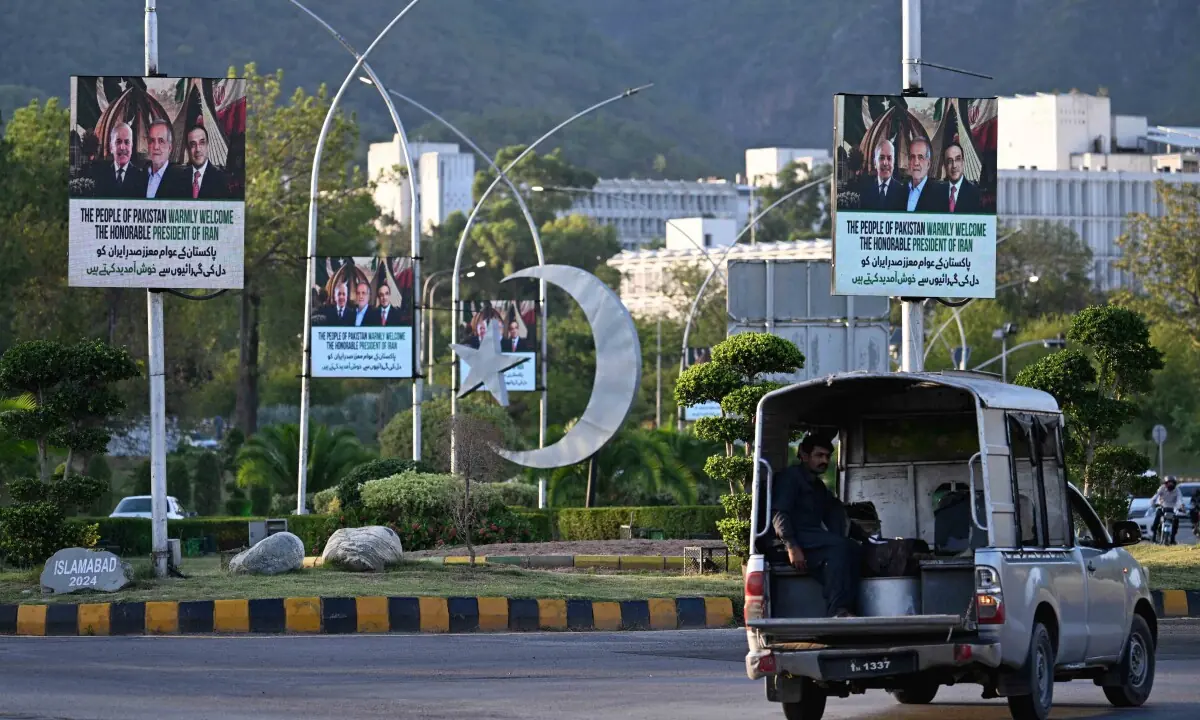
Iranian President Masoud Pezeshkian arrived in Pakistan on Tuesday for an official visit at the invitation of Prime Minister Shehbaz Sharif, marking an important step in strengthening bilateral relations between the two neighboring countries. The high-level visit includes meetings with Pakistan’s top civilian leadership and discussions on regional cooperation, trade, energy, border security, and diplomatic engagement.
During his visit, President Pezeshkian is scheduled to meet President Asif Ali Zardari and hold detailed talks with Prime Minister Shehbaz Sharif. He will also meet Senate Chairman Yousuf Raza Gilani, National Assembly Speaker Ayaz Sadiq, and Deputy Prime Minister and Foreign Minister Ishaq Dar.
This is President Pezeshkian’s second official visit to Pakistan since assuming office. The visit provides both countries with an opportunity to review their long-standing bilateral relationship and explore new avenues of cooperation in trade, energy, regional connectivity, border management, and people-to-people exchanges.
The visit also follows recent diplomatic developments after the signing of the Islamabad Memorandum of Understanding (MoU), which aims to promote regional peace and strengthen cooperation. Both Pakistan and Iran are expected to discuss regional and international issues of mutual interest while reaffirming their commitment to peace, stability, and sustainable development.
Ahead of the Iranian president’s arrival, Islamabad witnessed extensive security arrangements. Authorities sealed the Red Zone, suspended operations at major bus terminals, implemented work-from-home policies for several government offices, and temporarily closed public hiking trails to ensure smooth security operations.
The federal government announced that ministries and government offices located within the Red Zone would operate remotely, while essential institutions, including the Prime Minister’s Office, Parliament, Ministry of Finance, Ministry of Foreign Affairs, and banking institutions, would continue functioning normally.
The visit also comes shortly after direct talks between the United States and Iran in Switzerland under the Islamabad MoU framework. The discussions focused on regional peace, reopening the Strait of Hormuz, and creating mechanisms to reduce tensions in the Middle East.
Officials from both Pakistan and Iran view the visit as an opportunity to further deepen diplomatic, economic, and strategic cooperation while promoting regional stability and mutual prosperity.